Headlong Hall
Thomas Love Peacock
Chapter One. The Mail
AUTHOR: 'All philosophers who find
Some favourite System to their mind,
In every point to make it fit,
Will force all Nature to submit.'
HOST: CFUV present an Adaptation of Thomas Love Peacock’s Headlong Hall:
 2nd
NARRATOR:
The
uncertain
light
of
a
December
morning,
peeping
through
the
windows
of
the
Holyhead
Mail-coach,
dispels
the
dreams
of
the
four
inside
passengers who, through the first seventy
miles of road, have been trying to sleep with as much comfort as
may be consistent with the jolting of the vehicle, and an occasional
admonition to ‘Remember the Coachman,’ thundered through the
open door - accompanied by the gentle breath of the North Wind - into
the ears of the drowsy traveller.
2nd
NARRATOR:
The
uncertain
light
of
a
December
morning,
peeping
through
the
windows
of
the
Holyhead
Mail-coach,
dispels
the
dreams
of
the
four
inside
passengers who, through the first seventy
miles of road, have been trying to sleep with as much comfort as
may be consistent with the jolting of the vehicle, and an occasional
admonition to ‘Remember the Coachman,’ thundered through the
open door - accompanied by the gentle breath of the North Wind - into
the ears of the drowsy traveller.
3rd NARRATOR: A lively remark, that ‘the day is none of the finest,’ having elicited a repartee of ‘quite the contrary,’ the various knotty points of Meteorology, which usually introduce English conversations, are discussed and exhausted; and, the ice being thus broken, the colloquy rambles to other topics, in the course of which it emerges, to their surprise, that all four, though perfect strangers, are bound to the same destination: Headlong Hall, seat of the ancient and honourable family of the Headlongs, in the Vale of Llanberris, Caernarvonshire.
1st NARRATOR: Their name may seem not as truly Cambrian, as Morgan and Owen; Evans and Parry; and Jones; but still the Headlongs claim to be as genuine derivatives from the antique branch of Cadwallader as any of these other families. By one account, indeed, they claim superior antiquity to them all, and even to Cadwallader himself: a tradition having been handed down in Headlong Hall for a few thousand years, that in the Deluge the family’s founder was preserved on the summit of Snowdon, and, through his accompanying the water as it receded, till eventually he landed comfortably on the rocks of Llanberris, took the name of Rhaiader, meaning Waterfall.
3rd NARRATOR: But in later days, when commercial bagsmen - or Riders - began to scour the country, his descendants, to avoid unfavourable associations, dropped the name Rhaiader in favour of its English equivalent, Waterfall; and later, not liking the sound of the Thing, they substituted the Quality, and so adopted the name Headlong.
AUTHOR: 'I cannot tell how the Truth may be:
I say the Tale as ’twas said to me.'
1st NARRATOR: Like other squires, Harry Headlong,the present representative of this ancient house, is fond of hunting, racing, drinking, and other such amusements. Unlike others, however, he allows certain phenomena called Books to find their way into his house; and through lounging over them after dinner, on occasions when he must take his bottle alone, he becomes seized with a passion to be thought a Philosopher and Man of Taste; and accordingly makes an expedition to Oxford, to inquire for people of that kind; but being assured by a learnèd professor that there are none such in the University there, he proceeds to London, where, after beating up in several bookshops, theatres, exhibition-rooms, and other resorts of Literature and Taste, he forms an extensive acquaintance with Philosophers and Dilettanti; and wishing to have them all together in Headlong Hall, arguing, over his Burgundy, various knotty points which puzzle him, he invites them to his house for Christmas.
AUTHOR: The fame of his kitchen induces most of them to accept; and now four of these guests, from various parts of the Metropolis, occupy the corner seats of the Holyhead Mail:
FOSTER: Mr Foster, a Perfectibilian ...
AUTHOR: (... about thirty years of age, thin, with aquiline nose, black eyes, white teeth, and black hair ...)
ESCOT: Mr Escot, a Deteriorationist ...
AUTHOR: (... younger, but more pale and saturnine in his aspect ...)
JENKISON: Mr Jenkison, a Statu-quo-ite ...
AUTHOR: (... a round-faced little gentleman of about forty-five ...)
GASTER: ... and the Reverend Dr Gaster ...
AUTHOR: (... who, though of course neither a Philosopher
nor a Man of Taste, has, by a learnèd dissertation on ‘The
Art of Stuffing a Turkey,’ so won the Squire's fancy that he
concludes no Christmas party can be complete without him ...)
The conversation soon becomes animated; and Mr Foster praises the
vehicle they are travelling in, and observes what remarkable
Improvements have been made in travel between distant parts of the
kingdom: he holds forth energetically on roads and railways; canals and
tunnels; and manufactures and machinery:
FOSTER: ... In short, everything we look on attests the Progress of Mankind in all the Arts of Life, and demonstrates their gradual advancement towards a state of Unlimited Perfection.
AUTHOR: Mr Escot takes up the thread of the discourse, observing that the proposition just advanced seems to him perfectly contrary to the true state of the case:
ESCOT: ... For these Improvements, as you call them, are links in that Great Chain of Corruption which will fetter the human race in slavery and wretchedness: your Improvements proceed in a simple ratio, whereas the contrived wants they engender grow in compound fashion; thus one generation acquires fifty wants, and fifty means of supplying them are invented, each of which engenders two new wants: hence the next generation has a hundred wants, the next two hundred, and so on, until humans become helpless compounds of perverted inclinations and lose all independence of character; and by its own imbecility and vileness the whole Species must at last become extinct.
AUTHOR: Here, Mr Jenkison intervenes:
JENKISON: Your two opinions seem utterly opposed. I have often debated the matter in my own mind, Pro and Con, and have arrived at this conclusion: that in the human race there is no tendency either to moral Perfectibility or Deterioration; but both are so exactly balanced by their reciprocal results, that the Species, with respect to the sum of Good and Evil, Knowledge and Ignorance, Happiness and Misery, remains exactly and perpetually In Statu Quo.
FOSTER: Surely, you cannot maintain such a proposition in the face of evidence so luminous. Look at the Progress of all the Arts and Sciences - see Chemistry, Botany, Astronomy ...
ESCOT: Surely, experience deposes against you. Look at the rapid growth of Corruption, Luxury, Selfishness ...
AUTHOR: ... Now Dr Gaster breaks in:
GASTER: Really, gentlemen, this is a very Sceptical, and, I must say, Atheistical conversation, and I should have thought, out of respect to my Cloth ...
AUTHOR: Here the coach stops, and the coachman opens the door and roars, ‘Breakfast, gentlemen!’ - which so gladdens the ears of the divine, that he springs from the vehicle with an alacrity which induces a twisting of his ankle, and he limps into the inn, supported by Mr Escot and Mr Jenkison.
ESCOT: You should be expecting nothing but Evil, and therefore not be surprised at this little accident.
JENKISON: ... Although the comfort of a good breakfast, and the pain of a sprained ankle, do pretty exactly balance each other ...
Return to TopChapter Two. The Squire; the Breakfast
1st NARRATOR: Squire Headlong, meanwhile, is quadripartite in his locality; that is, he superintends the operations in four scenes of action - namely, Cellar; Library; Picture-Gallery; and Dining-Room - preparing for the reception of his Philosophical and Dilettanti visitors. His subordinate, the Butler, chases about the house after his master, wiping his forehead and panting for breath, while the Squire bounces from room to room like a cracker.
3rd NARRATOR: Multitudes of packages arrive, by land and water, from Chester, Liverpool, and Birmingham; Manchester and London; and from among the Mountains: Books, cheese, mathematical instruments, turkeys; Telescopes, hams; Flutes, sugar, electrical machines; Spices, air-pumps, eggs, French horns, drawing books; Scenery for a private theatre; Pickles, patent lamps, barrels of oysters, looking-glasses; and Jars of Portugal grapes. These, coming rapidly and endlessly, are deposited randomly, as the convenience of the moment dictates: Sofas in the Cellar; Chandeliers in the Kitchen; Hampers of ale in the Drawing-Room; and Fiddles and Fish-sauce in the Library.
1st NARRATOR: The servants, unpacking all these in furious haste, and flying with them from place to place - according to the tumultuous directions of Squire Headlong and the Butler who fumes at his heels - tumble over one another, upstairs and down. All is bustle and confusion; yet nothing seems to advance: while the Squire’s impetuosity ferments to the highest degree of exasperation.
2nd NARRATOR: In this state of eager preparation we leave Headlong Hall’s happy inhabitants, and return to the unfortunate divine limping with his sprained ankle into the breakfast-room of the inn, where his supporters deposit him safely in a large armchair, with his wounded leg stretched out on another.
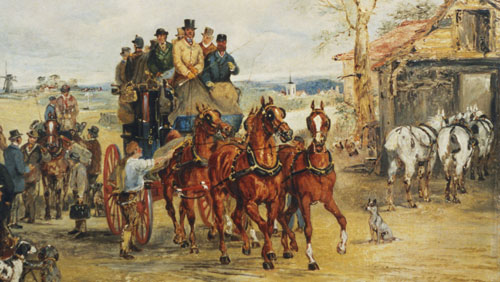 AUTHOR: The morning being cold, he contrives to be seated
as near the fire as is consistent with his other object of having
perfect
access to the table: which contains not only the ordinary comforts of
tea and toast, but also a supply of new-laid eggs, and a magnificent
round of Beef; against which Mr Escot immediately directs all the
artillery of his eloquence, declaring the use of Animal food,
conjointly with Fire, to be a principal cause of the Degeneracy of
Mankind:
AUTHOR: The morning being cold, he contrives to be seated
as near the fire as is consistent with his other object of having
perfect
access to the table: which contains not only the ordinary comforts of
tea and toast, but also a supply of new-laid eggs, and a magnificent
round of Beef; against which Mr Escot immediately directs all the
artillery of his eloquence, declaring the use of Animal food,
conjointly with Fire, to be a principal cause of the Degeneracy of
Mankind:
ESCOT: Natural Man lived in the woods: fruits of the earth supplied his simple nutriment: he had few desires, and no diseases. But when he began to sacrifice victims on the Altar of Superstition, to pursue goat and deer, and, by the pernicious invention of Fire, to pervert their Flesh into food: then Luxury, Disease, and premature Death were let loose on the world. Clearly, such is the correct interpretation of the fable of Prometheus, which is a symbolical portraiture of that disastrous epoch when man first applied Fire to culinary purposes, thereby surrendering his liver to the vulture of Disease. From that period the stature of mankind has been diminishing and, I doubt not, will so continue, till the whole Race shall vanish from the Earth.
FOSTER: I cannot agree: the use of Fire was indispensably Necessary, to give being to the various Arts of Life, which, in their interminable Progress, will finally conduct the entire race to the philosophic pinnacle of Pure and Perfect Felicity.
JENKISON: In the controversy concerning Animal and Vegetable food, there is much to be said on both sides; and, the question being in equipoise, I content myself with a Mixed diet, and eat whatever is placed before me - provided it be good in its kind.
AUTHOR: This opinion his two brother philosophers support through their Actions, even though they run down the Theory as highly detrimental to the best interests of Man. And then ...
GASTER: I am astonished - really astonished, gentlemen, at the heterodox opinions you have delivered: since nothing can be more obvious than that all animals were created solely and exclusively for the use of Man.
ESCOT: Even the Tiger that devours him?
GASTER: Certainly.
ESCOT: How do you prove it?
GASTER: It requires no proof: it is a point of Doctrine. It is Written, therefore it is so.
JENKISON: Nothing can be more logical. It has been said, that the Ox was expressly made to be eaten by Man: By equal reasoning, one may say that Man was expressly made to be eaten by the Tiger - although as wild Oxen exist where there are no Men, and Men where there are no Tigers, it would seem that in those instances they do not properly answer the Ends of their Creation.
GASTER: It is a Mystery.
ESCOT: Not to launch into the question of Final Causes ...
AUTHOR: (... remarks Mr Escot, helping himself to a slice of Beef ...)
ESCOT: ... concerning which I will candidly acknowledge I am as profoundly ignorant as the most dogmatical Theologian possibly can be, I just wish to observe, that the pure and peaceful manners which characterise many nations (the Hindoos, for example, who subsist exclusively on the fruits of the earth), depose strongly in favour of a Vegetable regimen.
FOSTER: It may be said, on the contrary, that Animal food acts on the mind as manure does on flowers, forcing them into a degree of expansion they would not otherwise have attained. If we can imagine a philosophical Auricula falling into a theoretical meditation on its Original, Natural nutriment, till it worked itself up into a profound abomination of bullock's blood, and sugar-baker's scum, and other Unnatural ingredients of that rich compost which had brought it to perfection, and insisted on being planted in common earth, it would have on its side all the advantage of Natural theory; but it would soon discover the practical error of its retrograde experiment by its inferiority in strength and beauty to all the Auriculas around it. In some instances at least, this analogy holds true with respect to Mind. No one will make a comparison, in mental power, between Hindoos and ancient Greeks.
ESCOT: The anatomy of the human stomach, and the formation of the teeth, clearly place man in the class of Frugivorous animals.
FOSTER: Many anatomists are of a different opinion, and agree in discerning the characteristics of the Carnivorous classes.
JENKISON: I am no anatomist, and cannot decide where doctors disagree; in the meantime, I conclude that man is Omnivorous, and on that conclusion I act.
GASTER: Your conclusion is truly Orthodox; indeed, the Loaves and Fishes are typical of a Mixed diet; and the practice of the Church in all ages shows ...
ESCOT: ... that it never loses sight of the Loaves and Fishes.
GASTER: ... it never loses sight of any point of sound Doctrine.
AUTHOR: The coachman now informs them their time is elapsed; nor can the remonstrances of the reverend divine, who declares he has not half breakfasted, succeed in gaining one minute from the inexorable charioteer ...
AUTHOR: When they are again in motion, Mr Foster resumes:
FOSTER: You will allow, that the Wild Man of the Woods could not transport himself over two hundred miles of forest, as easily as our vehicle transports us through this cultivated country.
ESCOT: I am certain that a Wild Man can travel an immense distance without fatigue; but what is the advantage of locomotion? The Wild Man is happy in one spot, and there he remains: the Civilised Man is wretched in every place he finds himself, and then congratulates himself on possessing a machine that will whirl him to another, where he will be just as miserable.
2nd NARRATOR: We now leave the mail-coach to find its way to Capel Cerig, the nearest point on the Holyhead road to Headlong Hall ...
Return to TopChapter Three. The Arrivals
Caprioletta:
‘O Mary, my sister, thy sorrow give o’er,
I soon shall return, girl, and leave thee no more:
But with children so fair, and a husband so kind,
I shall feel less regret when I leave thee behind.
‘I have made thee a bench for the door of thy cot,
And more would I give thee, but more I have not:
Sit and think of me there, in the warm summer day,
And give me three kisses, my labour to pay.’
She gave him three kisses, and forth did he fare,
And long did he wander, and no one knew where;
And long from her cottage, through sunshine and rain,
She watched his return, but he came not again.
1st NARRATOR: In the midst of that scene of confusion, in which we left Headlong Hall’s inhabitants, arrives the lovely Caprioletta Headlong, the Squire's sister - whom he has sent for, from her aunt’s residence at Caernarvon, to do the honours of his house - beaming like light on chaos, to arrange disorder and harmonise discord. The tempestuous spirit of her brother becomes as smooth as the surface of the Lake of Llanberris; and the Butler ‘plesses Cot, and St Tafit, and the peautiful tamsel,’ for being permitted to move about the house in his natural pace. Within twenty-four hours after her arrival, everything is disposed in its proper station - and the Squire becomes impatient for the appearance of his guests.
AUTHOR: The first to arrive is Marmaduke Milestone, Esquire ...
MILESTONE: (... a Picturesque Landscape Gardener of the first celebrity ...)
AUTHOR: ... with portfolio under his arm, and hopes of persuading Squire Headlong to put the grounds of his estate under a process of Improvement ...
MILESTONE: (... promising a signal triumph for my Art in the difficult and therefore glorious achievement of Polishing and Trimming the rocks of Llanberris ...)
 AUTHOR: Now comes Dr Gaster, in
a post-chaise from Capel
Cerig ...
AUTHOR: Now comes Dr Gaster, in
a post-chaise from Capel
Cerig ...
2nd NARRATOR: At Capel Cerig, where the mail-coach deposits its passengers, there is only one post-chaise to be had; so they decide that the doctor will travel in the chaise with the luggage, while the three philosophers walk. The chaise windows have unfortunately long ago lost their glass; but the divine has no alternative but to proceed, comforting himself with choice quotations from the Book of Job. The road leads along the edges of tremendous chasms, with torrents dashing in the bottom; so that, were his teeth not chattering with cold, they would chatter with fear ...
AUTHOR: The Squire shakes his hand heartily:
HEADLONG: I congratulate you, reverend sir, on your safe arrival at Headlong Hall.
GASTER: I assure you, Squire Headlong, that your congratulation is by no means misapplied.
AUTHOR: Next come the three philosophers, delighted with their walk and full of exclamations of rapture on the Sublime beauties of the Scenery.
GASTER: I confess that I prefer the Scenery of Putney and Kew, where a man can go comfortably to sleep in his chaise, without being in momentary terror of being hurled headlong down a precipice.
AUTHOR: Meanwhile, Mr Milestone has been looking around:
MILESTONE: I observe great Capabilities in the Scenery, but it needs Shaving and Polishing. If I could have it under my care for but a twelvemonth, I assure you that no one would know it again.
JENKISON: I believe the Scenery is just what it ought to be, and requires no alteration.
FOSTER: The Scenery could be improved, but I doubt if that would be achieved by Mr Milestone’s system.
ESCOT: I do not think anyone could improve the Scenery, but have no doubt that it has changed considerably for the worse, since the days when Snowdon’s now-barren rocks were covered with immense forest, which must have contained a fine race of Wild Men, not less than ten feet high.
1st NARRATOR: The next arrivals are Mr Cranium, and his lovely daughter Cephalis who flies to the arms of her dear friend Caprioletta, with all that warmth of friendship which young ladies usually assume towards each other in the presence of men. Cephalis blushes like a Carnation at the sight of Mr Escot, and Mr Escot glows like a Corn-Poppy on seeing Miss Cephalis.
AUTHOR: It is clear to all observers that he can imagine the possibility of at least one change for the better, even in this terrestrial Theatre of Universal Deterioration.
3rd NARRATOR: Mr Cranium's eyes wander from Mr Escot to his daughter, and from his daughter to Mr Escot; and his complexion, in the course of this scrutiny, undergoes several variations, from the dark red of the Peony to the deep blue of the Convolvulus.
ESCOT: (Formerly I had been the accepted suitor of Cephalis, till I incurred the indignation of her father by laughing at a profound Craniological dissertation which the old gentleman delivered; nor have I yet discovered the means of mollifying his wrath.)
1st NARRATOR: Mr Cranium carries in his hands a bag, the contents of which are too precious to be entrusted to any one else; and entreats to be shown to the chamber appropriated for his reception, that he may safely deposit his treasure. Accordingly the Butler conducts him to his room.
AUTHOR: Next to arrive are a profound critic, Mr Geoffrey Gall, who follows the trade of Reviewer, but occasionally indulges himself in composing bad Poetry; and a multitudinous Versifier, Mr MacLaurel, who follows the trade of Poet, but occasionally indulges himself in composing bad Criticism.
AUTHOR: The last arrivals are Mr Cornelius Chromatic ...
CHROMATIC: (... the most Profound and Scientific of all amateurs of the Fiddle ...)
AUTHOR: ... with his two blooming daughters, Miss Tenorina and Miss Graziosa; ... and Sir Patrick O'Prism, baronet ...
Sir PATRICK: (... a dilettante Painter of High Renown ...)
AUTHOR: ... with his aunt, Miss Philomela Poppyseed, an indefatigable Compounder of Novels written for the purpose of supporting every species of Superstition and Prejudice; ... and Mr Panscope ...
PANSCOPE: (... the mathematical, geological,astronomical, metaphysical, galvanistical, physiological, critical Philosopher ...)
AUTHOR: ... who has run through the whole circle of the
Sciences, and understands them all equally well ...
Mr Milestone is impatient to take a walk round the grounds ...
MILESTONE: (... so that I may examine how far the system of Clumping and Levelling can be carried advantageously into effect ...)
AUTHOR: ... The ladies retire to enjoy each other's society in
these first happy moments of meeting; ... Dr Gaster sits by the library
fire, meditating over the ‘Food-Lover’s Almanack’; ... Mr
Panscope sits in the opposite corner with Rees's Cyclopaedia;
... Mr Cranium is busy upstairs; ... and Mr Chromatic retreats to the
Music-room,
where he fiddles through a book of solos before the ringing of the
first dinner-bell ...
The remainder of the party support Mr Milestone's proposition; and,
accordingly, Squire Headlong and Mr Milestone leading, they commence
their perambulation.
Chapter Four. The Grounds
MILESTONE: I perceive, these grounds have never been touched by the finger of Taste.
HEADLONG: The place is a Wilderness: for during the latter
part
of my father's life, while I was ‘finishing my Education,’ he
troubled himself about nothing but
the Cellar, and suffered all else to go to rack and ruin. A
Wilderness, as you see, even now in December; but in summer a
Plantation of nettles, a Forest of thistles, with no livestock but
goats, which have eaten up the bark of the trees ...
Here you see the pedestal of a statue, with only half a leg and four
toes remaining: there were once many statues here. As a boy, I used to
sit on the shoulders of Hercules: what became of him I
could never ascertain. Atlas had his head knocked off to prop
up a shed; and only the other day we fished Bacchus out of the
horse-pond.
 MILESTONE: Accord me your permission, my dear sir, to wave
the wand of Enchantment over your grounds. The rocks shall be blown up;
the
trees shall be cut down; the Wilderness and its goats shall vanish like
mist. Pagodas and Chinese bridges; gravel walks and shrubberies;
bowling-greens, canals, and clumps of larch: shall rise upon its ruins.
MILESTONE: Accord me your permission, my dear sir, to wave
the wand of Enchantment over your grounds. The rocks shall be blown up;
the
trees shall be cut down; the Wilderness and its goats shall vanish like
mist. Pagodas and Chinese bridges; gravel walks and shrubberies;
bowling-greens, canals, and clumps of larch: shall rise upon its ruins.
One age, sir, has brought to light the treasures of
ancient Learning; another has penetrated the depths of
Metaphysics; but
it was reserved for the exclusive genius of the present times,
to invent the Noble Art of Picturesque Gardening, which has given a new
tint to the complexion of Nature, and a new outline to the physiognomy
of the Universe!
AUTHOR: Sir Patrick O'Prism, baronet (Painter of High Renown) intervenes:
Sir PATRICK: Give me leave, to take exception to that claim. Your system of Levelling, Trimming and Cropping, Clumping and Polishing, destroys all the beautiful intricacies of natural luxuriance, all the graduated harmonies of light and shade, melting into one another as you see them on that rock yonder. I never see one of your Improved places, as you call them - and which are nothing but big bowling-greens, like sheets of green paper, with a parcel of round clumps scattered over them, like so many spots of ink, flicked at random out of a pen, and here and there a solitary animal looking as if it were lost - without thinking it is for all the world like Hounslow Heath, thinly sprinkled with bushes and highwaymen.
MILESTONE: Sir, you will have the goodness to distinguish between the Picturesque and the Beautiful.
Sir PATRICK: Will I? Och! but I won't. For what is beautiful? That which pleases the eye. And what pleases the eye? Tints variously broken and blended. And these constitute the picturesque.
AUTHOR: Mr Gall now puts a word in:
GALL: Allow me. I do distinguish the Picturesque and the Beautiful; and I add to them, in the laying out of grounds, a third and distinct character, which I call Unexpectedness.
MILESTONE: Pray, sir, by what name do you distinguish this character, when a person walks round the grounds for the second time?
AUTHOR: Mr Gall bites his lips, and inwardly vows to revenge himself on Milestone, by cutting up his next publication.
3rd NARRATOR: A long controversy now ensues concerning the Picturesque and the Beautiful, highly edifying to Squire Headlong.
AUTHOR: ... Meanwhile, the three philosophers stop, at a projecting point of rock, to contemplate a little boat as it glides over the tranquil surface of the lake below:
FOSTER: The blessings of Civilisation extend themselves to the meanest individuals of the Community. That boatman, singing as he sails along, is doubtless a happy and, compared to men of his class some centuries back, an enlightened and intelligent man.
ESCOT: As a partisan of the system of the Moral Perfectibility of the human race ...
AUTHOR: ... says Mr Escot, who is always for considering things on a large scale, and whose thoughts immediately leap from lake to Ocean, from little boat to Ship-of-the-line ...
ESCOT: ... you will probably be able to point out to me the improvement that you suppose has taken place in the character of a sailor, from those days when Jason sailed on the Argo, or Noah moored his Ark on the summit of Ararat.
FOSTER: If you talk to me of mythological personages, of course I cannot meet you on level grounds.
ESCOT: Let us begin, then, no further back than the Battle of Salamis; and I ask you if the mariners of England are, in any respect, morally or intellectually, superior to those who preserved the liberties of Greece, under the direction of Themistocles?
FOSTER: I venture to assert that, considered as sailors, which is the only fair mode of judging them, they are as far superior to the Athenians, as our ships are superior to theirs. Would not one English Seventy-four-gun ship, think you, have been sufficient to sink, burn, and put to flight, all the Persian and Greek vessels in that memorable bay? Contemplate the progress of naval architecture, by which it has attained its present stage. In this, as in all other branches of Art and Science, each generation possesses all the knowledge of the preceding, and adds its own discoveries in a progression to which there seems no limit. The skill requisite to direct these immense machines is proportionate to their magnitude and complicated mechanism; and therefore the English sailor, considered as a sailor, is vastly superior to the ancient Greek.
ESCOT: You make a distinction, of course, between Scientific and Moral perfectibility?
FOSTER: I conceive that men are virtuous in proportion as they are Enlightened; and that, as each generation increases in Knowledge, it also increases in Virtue.
ESCOT: I wish it were so, but the reverse appears to be the fact. The progress of Knowledge is not general: it is confined to a chosen few. Most of mankind are beasts of burden, tools of their superiors. By enlarging and complicating your machines, you degrade, not exalt, the humans you employ to operate them. When the Bosun of a Seventy-four pipes all hands to the main tack, and flourishes his rope’s end over the shoulders of the poor fellows who are tugging at the ropes, do you perceive so dignified, so gratifying a picture, as Ulysses exhorting his dear friends, to ply their oars with energy? You will say, Ulysses was a fabulous character. But his vessel’s economy is drawn from Nature. Each man on board has a will of his own. He talks to them, argues with them, convinces them; and they obey him, because they love him, and know the reason of his orders. Now, all singleness of character is lost. The sciences advance. True. With a few years’ study a modern mathematician possesses more than Newton knew, and can add new discoveries of his own. Agreed. But does this make him a Newton? Does it give him that range of intellect, that grasp of mind, from which sprang Newton’s discoveries? Energy; Individuality; Benevolence: these qualities I desire to find, and yet are scarcer in each succeeding age. Rarely can there be found a single individual man: a few classes compose the whole frame of society, and when you know one of a class you know all of it. Give me the Wild Man of the Woods; the Original, unscientific, unlogical Savage: in him there is at least some good; but in a civilised, mechanical, calculating Slave of Mammon, there is none.
AUTHOR: Mr Foster is preparing to reply, when the dinner-bell rings, and he immediately commences a precipitate return towards the house; followed by his two companions, who both admit that he is now leading the way to at least a temporary period of Physical Amelioration ...
ESCOT: ... But, alas! ... ‘Protracted banquets have been copious sources of evil.’
Return to TopChapter Five. The Dinner
AUTHOR: The sun is terminating his diurnal course, and the lights glitter on the festal board. The ladies have retired, and the Burgundy has taken two or three tours of the table ...
HEADLONG: Push about the bottle: Mr MacLaurel, it stands with you.
MacLAUREL: Really, Squire Headlong, this is the vara nectar itsel. Ye hae saretainly descovered the terrestrial paradise, but it flows wi’ a better leecor than milk an’ honey.
GASTER: Hem! Mr MacLaurel! there is a degree of profaneness in that observation, which I should not have looked for in so staunch a supporter of Church and State. Milk and honey was the pure food of the antediluvian patriarchs, who knew not the use of the grape, happily for them ...
AUTHOR: ... pronounces Dr Gaster, tossing off a bumper of Burgundy.
ESCOT: Happily indeed! The world’s first inhabitants knew the use neither of Wine nor Animal food; it is therefore credible that they lived to the age of several centuries, free from war, commerce, arbitrary government, and every other wickedness. But Man was then a different animal: without the faculty of speech; unencumbered with clothes; living in the open air. His first dwellings, of course, were hollows in trees and rocks. Later he began to build: thence grew villages; then cities. Oppression, poverty, and disease have kept pace with his pretended improvements, till from a free, healthy, peaceful animal, he has become a weak, distempered, carnivorous slave.
GASTER: When you assert that Original Man was unencumbered with clothes, and lived in the open air, your doctrine is Orthodox; but the faculty of speech he certainly did have, for the authority of Moses ...
ESCOT: ... Of course, sir, I do not presume to dissent from the exalted authority of that most enlightened Astronomer and profound Cosmogonist, who had, moreover, the advantage of being inspired; but when I indulge myself with a ramble in the fields of speculation, and attempt to deduce what is probable and rational from the sources of analysis, experience, and comparison, I confess I too often lose sight of the doctrines of that great fountain of Theological and Geological philosophy.
HEADLONG: Push about the bottle.
FOSTER: Do you suppose a Wild Man, living on acorns, and sleeping on the ground, comparable in felicity to a Newton, ranging through unlimited space, and penetrating into the arcana of universal motion; or a Milton, identifying himself with the beings of an invisible world?
ESCOT: You suppose extreme cases: but, on the score of happiness, what comparison can you make between the tranquil life of the Wild Man of the Woods and the wretched existence of Milton, victim of persecution, blindness and poverty? Literature demonstrates that Happiness and Intelligence seldom go together. Besides, always the many are sacrificed to the few. Where one man advances, hundreds retrograde; and always the balance favours Universal Deterioration.
FOSTER: Virtue is independent of external circumstances. The exalted understanding looks into the Truth of things, and, in its own peaceful contemplations, rises superior to the world. No philosopher would resign his mental acquisitions for the purchase of any terrestrial good.
ESCOT: Or, no one would resign his identity as the price of any acquisition. But anyone would effect a change in his material situation relative to other people. As for the rest of your argument, the understanding of Literary people is for the most part ‘exalted,’ as you express it, not so much by love of Truth and Virtue, as by arrogance and self-sufficiency; and there is less disinterestedness, less benevolence; and more envy and uncharitableness among them, than among any other people.
AUTHOR: The eye of Mr Escot rests innocently and unintentionally on Mr Gall.
GALL: You allude, sir, I presume, to my Review.
ESCOT: Pardon me, sir. You will be convinced I cannot possibly be alluding to your Review, when I assure you that I have never read a single page of it.
GALL and MacLAUREL: Never read our Review!
ESCOT: Never. I look on Periodical Criticism in general to be a species of Shop, where panegyric and defamation are sold, wholesale and retail. I am not inclined to be a Purchaser of these commodities, or to encourage a Trade which I consider pregnant with mischief.
MacLAUREL: I can readily conceive, sir, ye wou’d na wullinly encoorage ony dealer in panegeeric: but, frae the manner in which ye speak o' the first creetics an’ scholars o’ the Age, I shou’d think ye wou’d hae a leetle mair predilaction for deefamation.
ESCOT: I have no predilection, sir, for defamation. I make a point of speaking the truth; but the truth can seldom be spoken without some wounded person pronouncing it a libel.
GALL: You are perhaps, sir, an enemy to Literature in general?
ESCOT: If I were, sir, I should be a better friend to Periodical Critics.
GALL: May I take the liberty to inquire into the basis of your objection?
ESCOT: I conceive that Periodical Criticism disseminates superficial knowledge, and vanity; delivers biased and misleading opinions; and is conducted, not for the sake of Literature, but to serve the interests of particular individuals and groups.
MacLAUREL: Every mon, sir, leeves according to his ain notions of Honour an’ Justice: there is a wee defference amang the learned wi’ respect to the defineetion o’ the terms.
ESCOT: I believe it is generally admitted, that one of the ingredients of Justice is Disinterestedness.
MacLAUREL: It is na admetted, sir, amang the pheelosophers of Edinbroo’, that there is ony sic thing as desenterestedness in the warld: for ye mun observe, sir, every mon has his ain parteecular feelings of what is gude, an’ beautifu’, an’ consentaneous to his ain indiveedual nature. Sir, twa men shall purchase a piece o’ grund atween ’em, and the first mon shall cover his half wi’ a park ...
MILESTONE: ... beautifully laid out in lawns and clumps, with a belt of trees at the circumference, and an artificial lake in the centre ...
MacLAUREL: Exactly, sir: an’ shall keep it a’ for his ain sel: an’ the other mon shall divide his half into leetle farms of twa or three acres ...
ESCOT: ... like those of the Roman republic; and build a cottage on each of them, and cover his land with an innocent and smiling population, who shall owe their existence and happiness to his benevolence.
MacLAUREL: Exactly, sir: an’ ye will ca’ the first mon selfish, an’ the second desenterested; but the pheelosophical truth is semply this, that the ane indiveedual is pleased wi’ looking at trees, an’ the other wi’ seeing people happy an’ comfortable.
HEADLONG: Wake the Reverend. -- Doctor, the bottle stands with you.
GASTER: It is an error of which I am seldom guilty.
CRANIUM: I perfectly agree with Mr MacLaurel in his definition of Self-Love and Disinterestedness: every man's actions are determined by his peculiar views, which are determined by the organisation of his skull. A man in whom the organ of Benevolence is not developed, cannot be benevolent: he, in whom it is so, cannot be otherwise. In the greater number of subjects that I have observed, the organ of Self-Love is prodigiously developed.
ESCOT: Much less, I presume, among savage than civilised men.
CRANIUM: Very probably.
ESCOT: You have found copious specimens of the organs of Hypocrisy, Destruction, and Avarice.
CRANIUM: Secretiveness, Destructiveness, and Covetiveness. You may add, if you please, that of Constructiveness.
ESCOT: Meaning, I presume, the organ of Building; which I contend to be not a natural organ of the ‘Featherless Biped.’
CRANIUM: Pardon me: it is here ...
AUTHOR: ... producing a skull from his pocket, to the great surprise of the company, and placing it on the table ...
CRANIUM: ... This is the skull of Sir Christopher Wren. You observe this protuberance ...
ESCOT: I contend that original unsophisticated man was by no means constructive. He lived in the open air, under a tree.
GASTER: The Tree of Life. Unquestionably. Till he tasted the forbidden fruit.
JENKISON: At which time the organ of Constructiveness was added, as punishment for his transgression.
ESCOT: There could not have been a more severe one, since the propensity for building cities has proved the greatest curse of his existence.
HEADLONG:‘Memento mori.’
AUTHOR: ... says Squire Headlong, taking the skull ...
HEADLONG: ... Come, a bumper of Burgundy.
GALL: A very classical application, Squire Headlong. The Romans were in the practice of adhibiting skulls at their banquets, and sometimes little skeletons of silver, as a silent admonition to the guests to enjoy life while it lasted.
GASTER: Sound doctrine, Mr Gall.
ESCOT: I question its soundness. Wine has contributed tremendously to human Deterioration.
FOSTER: I fear, indeed, it operates as a considerable check to the progress of the species towards Moral and Intellectual Perfection. Yet many great men have been of opinion that it exalts the imagination, fires the genius, and imparts to dispositions naturally cold and deliberative that enthusiastic sublimation which is the source of greatness and energy.
GALL:‘Homer is proved to be a lover of wine, by the praises he bestows on it.’
JENKISON: I conceive the use of wine to be pernicious in excess, but useful in moderation: I find that an occasional glass, taken with caution, has a salutary effect in maintaining the Equilibrium of the System; and this temperate use of wine was, no doubt, what Homer meant to inculcate, when he said: ‘A cup of wine at hand, to drink as inclination prompts.’
HEADLONG: Good. Pass the bottle.
[A short silence.]
HEADLONG: Sir Christopher does not seem to have raised our spirits. Chromatic, favour us with a specimen of your vocal powers. Something in point.
CHROMATIC:
In his last binn Sir Peter lies,
Who knew not what it was to frown:
Death took him mellow, by surprise,
And in his cellar stopped him down.
Through all our land we could not boast
A knight more gay, more prompt than he,
To rise and fill a bumper toast
And pass it round with Three Times Three.
None better knew the feast to sway,
Or keep Mirth's boat in better trim;
For Nature had but little clay
Like that of which she moulded him.
No sorrow round his tomb should dwell:
More pleased his gay old ghost would be,
For funeral song, and passing bell,
To hear no sound but Three Times Three.
AUTHOR: Mr Panscope suddenly emerges from a deep reverie:
PANSCOPE: I have heard, with the most profound attention, everything which the gentleman on the other side of the table has thought proper to advance on the subject of Human Deterioration; and I must take the liberty to remark, that it augurs a considerable degree of presumption in any individual, to set himself up against the authority of so many great men, as may be marshalled in metaphysical phalanx under the opposite banners of the controversy: such as St Jerome, Confucius, the King of Prussia, Zoroaster, Hippocrates, Machiavelli, Solomon, Colley Cibber, and Erasmus.
ESCOT: I presume, sir, you are one of those who value an Authority more than a reason.
PANSCOPE: The authority, sir, of all these great men, whose works, as well as all the Encyclopedia Britannica, and the Memoirs of the Academy of Inscriptions, I have read through from beginning to end, deposes, with irrefragable refutation, against your ratiocinative speculations, wherein you seem desirous, by the futile process of analytical dialectics, to subvert the pyramidal structure of synthetically deduced opinions, which have withstood the secular revolutions of physiological disquisition, and which I maintain to be transcendentally self-evident, categorically certain, and syllogistically demonstrable.
HEADLONG: Bravo! Pass the bottle. The very best speech that ever was made.
ESCOT: It has only the slight disadvantage of being unintelligible.
PANSCOPE: I am not obliged, sir - as Dr Johnson observed on a similar occasion - to furnish you with an understanding.
ESCOT: I fear, sir, you would have difficulty in furnishing me with such an article from your own stock.
PANSCOPE: ’Sdeath, sir, do you question my understanding?
ESCOT: I only question, sir, where I expect a reply; which, from things that have no existence, I am not visionary enough to anticipate.
PANSCOPE: I beg leave to observe, sir, that my language was perfectly perspicuous, and etymologically correct; and, I conceive, I have demonstrated what I shall now take the liberty to say in plain terms, that all your opinions are extremely absurd.
ESCOT: I should be sorry, sir, to advance any opinion that you would not think absurd.
PANSCOPE: Death and fury, sir ...
ESCOT: Say no more, sir. That apology is quite sufficient.
PANSCOPE: Apology, sir?
ESCOT: Even so, sir. You have lost your temper, which I consider equivalent to a confession that you have the worst of the argument.
PANSCOPE: Lightning and devils! sir ...
HEADLONG: No civil war! - Temperance, in the name of Bacchus! - A glee! a glee! ‘Music has charms to bend the knotted oak.’ Sir Patrick, you'll join?
Sir PATRICK: Troth, with all my heart: for, by my soul, I'm bothered completely.
HEADLONG: Agreed, then: you, and I, and Chromatic. Bumpers! - bumpers! Come, strike up.
Sir PATRICK, HEADLONG, CHROMATIC:
A heeltap! a heeltap! I never could bear it!
So fill me a bumper, a bumper of claret!
EVERYBODY:
Let the bottle pass freely, don’t shirk it nor spare it,
For a heeltap! a heeltap! I never could bear it!
1st NARRATOR: The Butler now brings a summons from the ladies to tea and coffee. The Squire is unwilling to leave his Burgundy. Mr Escot urges the necessity of immediate adjournment, observing that the longer they continue drinking the worse they will become. Mr Foster seconds the motion, declaring the transition from the bottle to female society to be an indisputable Amelioration of the state of the sensitive man. Mr Jenkison allows the Squire and his two brother philosophers to settle the point between them, concluding that he is just as well in one place as another. The question of adjournment is put, and carried by a majority.
Return to TopChapter Six. The Evening.
AUTHOR: Mr Panscope, highly irritated by the cool contempt with which Mr Escot has treated him, sits sipping his coffee and meditating revenge. He is aware of his antagonist’s passion for the beautiful Cephalis, for whom he himself has some predilection; also, obviously some anger still lurks in her father’s mind, unfavourable to Mr Escot’s hopes.
1st NARRATOR: After deliberation, the stimulus of revenge, on top of predilection, decides him to cut out Mr Escot in the young lady's favour. The practicality of this design he does not investigate; for the havoc he has made in the hearts of some silly girls who are extremely vulnerable to flattery, and who, not understanding a word he says, call him a ‘prodigious clever man,’ has convinced him of his own irresistibility. Further, he can fiddle with tolerable dexterity (though by no means so quick as Mr Chromatic: and as we know, rapidity of execution, not delicacy of expression, constitutes the scientific perfection of Modern Music) and can warble a fashionable love-ditty with considerable affectation of feeling: besides this, he is always extremely well dressed - and is heir-apparent to an estate of ten thousand a year.
3rd NARRATOR: The influence which this last consideration may have on the minds of most of his female acquaintance, whose morals have been formed by the novels of such writers as Miss Philomela Poppyseed, do not once enter into his calculation of his own personal attractions. Relying, therefore, on past success, he determines to ‘appeal to his fortune,’ and already considers himself sole lord and master of the affections of the beautiful Cephalis.
Caprioletta:
Her children grew up, and her husband grew grey,
She sat on the bench through the long summer day
One evening, when twilight was deep on the shore,
There came an old soldier, and stood by the door.
In English he spoke, and none knew what he said,
But her oatcake and milk on the table she spread;
Then he sate to his supper, and blithely he sung,
And she knew the dear sounds of her own native tongue:
‘O rich are the feasts in the Englishman's hall,
And the wine sparkles bright in the goblets of Gaul:
But their mingled attractions I well could withstand,
For the milk and the oatcake of Meirion’s dear land.’
1st NARRATOR: Of the party who enter the Library, to which the ladies have retired, only Mr Foster and Mr Escot are perfectly sober. Mr Foster places himself near the lovely Caprioletta, whose artless and innocent conversation has already made an impression on his susceptible spirit. Mr Escot sits next to the beautiful Cephalis: Mr Cranium has laid aside much of the terror of his frown; copious libations of Burgundy have smoothed his brow into unusual serenity; and Mr Escot’s craniological conversation with him has softened his heart in Mr Escot’s favour.
AUTHOR: Dr Gaster seats himself on a sofa near Miss Philomela Poppyseed, who details to him the plan of a very moral and aristocratical novel she is preparing, and is holding forth, with her eyes half shut, till a long-drawn nasal tone from the divine compels her suddenly to open them in surprised indignation. The cessation of her voice awakens him, and he murmurs:
GASTER: Admirably planned, indeed!
PHILOMELA: I have not quite finished, sir. Will you have the goodness to inform me where I left off?
GASTER: (Groping.) I think you had just laid down, that a thousand a year is an indispensable ingredient in the passion of Love, and that no man, who is not thus gifted by Nature, can reasonably presume to feel that passion himself, or be correctly the object of it with a well-educated female.
PHILOMELA: That, sir, is the fundamental principle which I lay down in the first chapter, and which the whole four volumes - which I have outlined to you - are intended to set in a strong practical light.
GASTER: Bless me! What a nap I must have had!
1st NARRATOR: Miss Philomela flings away to the side of her dear friend Gall, under whose fostering patronage she has been puffed into an extensive reputation much to the advantage of the young ladies of the Age, for she has taught them to consider themselves a sort of commodity, to be put up at public auction, and knocked down to the highest bidder. Mr MacLaurel joins them; and they secretly resolve, that Miss Philomela shall furnish them with a portion of her manuscripts, so that Mr Gall may devote the following morning to putting together a favourable review of her work.
3rd NARRATOR: While this amiable and enlightened trio are busily employed in flattering one another, Mr Cranium retires to complete preparations, begun in the morning, for a lecture which he intends later to present to the company: Sir Patrick walks in the grounds to study the effect of moonlight on the snow-clad mountains: Mr Foster and Mr Escot continue to pay attentions to their ladies; Mr Panscope ponders his plan of attack on the heart of Miss Cephalis; Mr Jenkison sits reading Much Ado About Nothing; Dr Gaster, still enjoying the benefit of Miss Philomela's opiate, serenades the company from his corner; and Mr Chromatic, reading music, occasionally hums a note. Mr Milestone opens his portfolio for the edification of Miss Tenorina, Miss Graziosa, and Squire Headlong, and points out the various beauties of his plan for Lord Littlebrain's park:
MILESTONE: This, you perceive, is the natural state of one part of the grounds. Here is a wood, never yet touched by the finger of Taste; thick, intricate, and gloomy. Here is a little stream, dashing from stone to stone, and overshadowed with untrimmed boughs.
TENORINA: The sweet romantic spot! How beautifully the birds must sing there on a summer evening!
GRAZIOSA: Dear sister! How can you endure the horrid thicket?
MILESTONE: You are right, Miss Graziosa: your taste is Correct - perfectly in order. Now, here is the same place Corrected - Trimmed - Polished - Adorned. Here sweeps a plantation, in a beautiful regular curve: there winds a gravel walk: here are parts of the old wood, in these majestic circular Clumps, disposed at equal distances with wonderful Symmetry: there are some single shrubs scattered in elegant profusion: here a Portugal laurel, there a juniper; here a rhododendron, there an arbutus. The stream, as you see, is become a canal: the banks, perfectly smooth and green, slope to the water’s edge - and there is Lord Littlebrain, rowing in an elegant boat.
HEADLONG: Magical, faith!
MILESTONE: Here is another part of the grounds in its natural state. Here is a large rock, with a mountain-ash rooted in its fissures, overgrown, as you see, with ivy and moss; and from this part of it bursts a little fountain, that runs bubbling down its rugged sides.
TENORINA: O how beautiful! How I should love the melody of that miniature cascade.
MILESTONE: Beautiful, Miss Tenorina? Hideous. Base, common, and Popular. Such a thing as you may see anywhere, in wild and mountainous districts. Now, observe the metamorphosis. Here is the same rock, cut into the shape of a giant. In one hand he holds a horn, through which that little fountain is thrown to a prodigious elevation. In the other is a ponderous stone, so exactly balanced as to be apparently ready to fall on the head of any person who may happen to be underneath - and there is Lord Littlebrain walking below it.
HEADLONG: Miraculous, by Mahomet!
MILESTONE: This is the summit of a hill, covered, as you perceive, with woods, and with those mossy stones scattered randomly under the trees.
TENORINA: What a delightful spot to read in, on a summer's day! The air must be so pure, and the wind must sound so divinely in the tops of those old pines!
MILESTONE: Bad Taste, Miss Tenorina. Bad Taste, I assure you. Here is the spot Improved. The trees are cut down: the stones are cleared away: this is an octagonal pavilion, exactly on the centre of the summit - and there is Lord Littlebrain with a telescope, on the top of the pavilion, enjoying the Prospect.
HEADLONG: Glorious. egad!
MILESTONE: Here is a rugged mountain road, leading through impervious shades: the ass and four goats characterise a wild uncultured scene. Here, as you see, it is totally changed into a beautiful gravel road, gracefully curving through a belt of limes - and there is Lord Littlebrain driving four-in-hand.
HEADLONG: Egregious, by Jupiter!
MILESTONE: Here is Littlebrain Castle, a Gothic, moss-grown structure, half-bosomed in trees. Near the casement of that turret is an owl peeping from the ivy.
HEADLONG: And devilish wise he looks.
MILESTONE: Here is the new house, without a tree near it, standing in the middle of an undulating lawn: a white, polished, angular building, reflected in this wave-less lake - and there is Lord Littlebrain peering out of the window.
HEADLONG: And devilish wise he looks too ... You shall cut me a giant before you go.
MILESTONE: Good. I'll order down my little corps of pioneers.
1st NARRATOR: Sir Patrick now enters, and, after rapturous exclamations on the effect of the mountain-moonlight, entreats that one of the young ladies will favour the company with a song. The beautiful Cephalis takes her station at the harp:
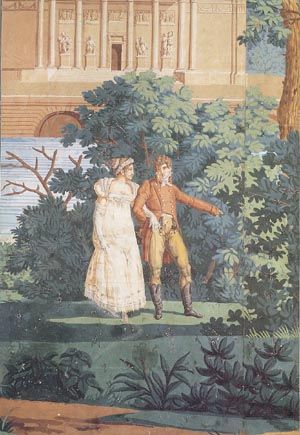 Cephalis:
Oh! who art thou, so swiftly flying?
My name is Love, the child replied:
Swifter I pass than south-winds sighing.
Or streams, through summer vales that glide
And who art thou, his flight pursuing?
’Tis cold Neglect whom now you see:
The little god you there are viewing,
Will die, if once he's touched by me.
Oh! who art thou, so fast proceeding,
Ne’er glancing back thine eyes of flame?
Marked but by few, through earth I'm speeding,
And Opportunity’s my name.
What form is that, which scowls beside thee?
Repentance is the form you see;
Learn then, the fate may yet betide thee:
She seizes them who seize not me.
AUTHOR: The Butler appears with a summons to Supper, after which the party disperse for the night.
Return to TopChapter Seven. The Walk
1st NARRATOR: At Headlong Hall, Breakfast is customarily ready at eight, and available till two; so that guests may variously rise at their own hour, breakfast when they will, and employ the morning as they think proper; the Squire expecting only that they assemble punctually at Dinner. During all this period, the Butler stands sentinel at a side-table near the fire, copiously furnished with tea, coffee, and chocolate; milk, cream, eggs; rolls, toast, muffins, bread, and butter; potted beef, cold fowl and partridge; ham, tongue, and anchovy.
3rd NARRATOR: The three philosophers make their appearance at eight, and enjoy their pick of the offerings. The morning being fine and frosty, and they being good pedestrians, they agree to walk to Tremadoc, to see the improvements carrying on in that vicinity.
1st NARRATOR: After their departure, Squire Headlong and Mr Milestone appear, and arrange, over their muffin and partridge, to walk to a ruined tower within the grounds, which Mr Milestone thinks he can Improve.
3rd NARRATOR: Other guests drop in by ones and twos, and make their various arrangements for the morning. Mr Panscope takes a little ramble with Mr Cranium, during which he professes a great Enthusiasm for the Science of Craniology, and a great deal of Love for the beautiful Cephalis, adding a few words about his Expectations: the old gentleman is unable to withstand this triple battery, and they accordingly determine - as in the Heroic Age, when it was deemed superfluous to consult the opinions and feelings of the lady on the manner in which she should be disposed of - that the lovely Miss Cranium shall be made the happy bride of the accomplished Mr Panscope. We leave them to settle preliminaries, while we accompany the three philosophers in their walk to Tremadoc.
2nd NARRATOR: The Vale contracts as they advance, and, when they have passed the termination of the Lake, their road winds along a narrow pass, bordered on both sides by perpendicular rocks, broken into the wildest forms of fantastic magnificence, through which an impetuous torrent dashes over vast pieces of stone.
ESCOT: These are, indeed, ‘fragments of a demolished world’: yet they must be feeble images of the valleys of the Andes, where the philosophic eye may contemplate the effects of that tremendous convulsion which destroyed the Perpendicularity of the poles, and inundated this globe with that torrent of Physical Evil, from which the greater torrent of Moral Evil has issued, that will continue, with expansive power and accelerated impetus, till the whole human race is swept away in its vortex.
FOSTER: The Precession of the Equinoxes will gradually ameliorate the Physical state of our planet till the Ecliptic shall again coincide with the Equator, when the equal diffusion of light and heat over the whole surface of the earth will typify the equal and happy existence of Man, in his final state of Pure and Perfect Intelligence.
JENKISON: lt is by no means clear that the axis of the earth was ever Perpendicular to the plane of its orbit, or that it ever will be. Explosion and convulsion are necessary to the maintenance of either hypothesis: for La Place has demonstrated that the Precession of the Equinoxes is only a Secular Equation of a very long period: - which of course proves nothing, one way or the other.
2nd NARRATOR: They now emerge by a winding ascent from the Vale of Llanberris, and after a little time arrive at Bedd Gelert. Proceeding through the sublime pass of Aberglaslynn, their road leads along the edge of Traeth Mawr, a vast arm of the Sea, which they behold in all the magnificence of the flowing tide. Another five miles brings them to the embankment, designed to connect the counties of Caernarvon and Meirionnydd, which has been extended from both coasts, and nearly meets in the centre. They walk to the extremity of the Caernarvonshire part. The tide is ebbing: it has filled the vast basin within, forming a lake about five miles in length and more than one in breadth.
 3rd NARRATOR: As they look
upwards with their backs to the
open sea, they behold a scene which no other in this country can
parallel, and which the admirers of the magnificence of Nature will
ever remember
with regret, whatever consolation may be derived from the probable
utility of the works which have excluded the waters from their ancient
receptacle. Vast rocks and precipices, intersected with little
torrents, form the barrier on the left: on the right, the triple summit
of Moëlwyn rears majestically: in the depth is that sea of
mountains, the wild and stormy outline of the Snowdonian chain, with
the giant Wyddfa towering in the midst.
3rd NARRATOR: As they look
upwards with their backs to the
open sea, they behold a scene which no other in this country can
parallel, and which the admirers of the magnificence of Nature will
ever remember
with regret, whatever consolation may be derived from the probable
utility of the works which have excluded the waters from their ancient
receptacle. Vast rocks and precipices, intersected with little
torrents, form the barrier on the left: on the right, the triple summit
of Moëlwyn rears majestically: in the depth is that sea of
mountains, the wild and stormy outline of the Snowdonian chain, with
the giant Wyddfa towering in the midst.
2nd NARRATOR: The tide ebbs rapidly: the waters within, retained by the embankment, pour through its two points an impetuous cataract, curling and boiling in innumerable eddies, and making a tumultuous melody admirably in harmony with the surroundings. The three philosophers look on in silence; and at length unwillingly turn away and proceed to the little town of Tremadoc, which is built on land recovered in a similar manner from the sea. After inspecting the manufactories, and refreshing themselves at the inn on a cold saddle of mutton and a bottle of sherry, they retrace their steps towards Headlong Hall, commenting as they go on their experiences.
ESCOT: I regret that time did not allow us to see the caves on the seashore. One is said to be of unknown depth. According to local tradition, an adventurous fiddler once resolved to explore it; he entered, and never returned; but the subterranean sound of a fiddle was heard at a farmhouse seven miles inland. It is, therefore, supposed that he lost his way in the labyrinth of caverns, supposed to exist under the rocky soil of this part of the country.
JENKISON: A supposition that must stand, unless a second fiddler, equally adventurous and more successful, should return with an accurate report of the facts.
FOSTER: What think you of the little colony - a city in its cradle - we have just been inspecting?
 ESCOT:
With all the weakness of infancy, and all the vices of
maturer age. I confess, the sight of those manufactories, which have
suddenly sprung up, like fungous excrescences, in the bosom of these
wild and desolate scenes, impressed me with as much horror and
amazement as the sudden appearance of the stocking manufactory struck
into the mind of Rousseau, when, in a lonely valley of the Alps, he had
just congratulated himself on finding an untouched spot.
ESCOT:
With all the weakness of infancy, and all the vices of
maturer age. I confess, the sight of those manufactories, which have
suddenly sprung up, like fungous excrescences, in the bosom of these
wild and desolate scenes, impressed me with as much horror and
amazement as the sudden appearance of the stocking manufactory struck
into the mind of Rousseau, when, in a lonely valley of the Alps, he had
just congratulated himself on finding an untouched spot.
FOSTER: The manufacturing system is not yet purified from some evils which necessarily attend it, but which I conceive are more than compensated by their concomitant advantages. Consider the vast sum of Human Industry to which this system so essentially contributes: seas covered with vessels; ports resounding with life; profound researches, scientific inventions; complicated machinery; canals carried over valleys and through hills: employment and existence thus given to innumerable families, and the multiplied comforts and conveniences of life diffused over the whole Community.
ESCOT: You present to me a complicated picture of artificial
life, and require me to admire it.
‘Seas covered with vessels’ - every one of which contains
several tyrants, and a crew of slaves,
ignorant, perverted, and active only in mischief.
‘Ports resounding with life’ - in other words, with
the mingled din of avarice, drunkenness and prostitution.
‘Profound researches, scientific inventions’ - to what
end? To
contract the sum of human wants? to teach the art of living on a
little? to disseminate independence,
liberty, and health? No: to multiply factitious desires, to stimulate
depraved appetites, to invent unnatural wants, to heap up incense on
the shrine of luxury, and accumulate expedients of selfish and ruinous
profusion.
‘Complicated machinery’ - behold its blessings.
Twenty years ago, at every cottage door sat the good woman with her
spinning-wheel. Where is that spinning-wheel now, and every simple
occupation of the industrious cottager?
ESCOT: Wherever this boasted machinery is established, the
children of the poor are death-doomed from their cradles. Look at
midnight into a cotton-mill, amidst the smell of oil, the smoke of
lamps, the rattling of wheels, the dizzy and complicated motions of
diabolical mechanism: contemplate the human machines that keep time
with the revolutions of the ironwork, robbed at night of their natural
rest, as by day of air and exercise: observe their pale and ghastly
features, in that baleful and malignant light, and tell me if you do
not fancy yourself on the threshold of Virgil's Hell, where
‘Cries now are heard,
The weeping of infant souls;
From them had been stolen
Their share of Life’s sweetness,
For the dark day had torn them from their mother’s breast ...’
ESCOT: ... Nor is the lot of the parents more enviable. Victims of unhealthy toil, they have neither the corporeal energy of the savage, nor the mentality of the civilised man. They are components of the machines which administer to the pampered appetites of the few, who consider themselves the most valuable part of society, because they consume in indolence the fruits of the earth, and contribute nothing to the benefit of the Community.
JENKISON: That these are evils cannot be denied; but they have their counterbalancing advantages. That a man should pass the day at a furnace and the night in a cellar, is bad for the individual, but good for others who enjoy the benefit of his labour.
ESCOT: By what right do they so?
JENKISON: By the right of Property and Possession: by the right of the Stronger.
ESCOT: Do you justify that principle?
JENKISON: I neither justify nor condemn it. It is practically recognised in all societies; and, though it is certainly the source of evil, it is also the source of good, or it would not have so many supporters.
ESCOT: That is by no means a consequence. Do we not every day see men supporting enormous evils, though an erroneous view of their own miserable self-interest induces them to think otherwise?
JENKISON: Good and evil exist only as they are perceived. I cannot therefore understand, how that which a man perceives to be good can be in reality an evil to him: indeed the word
‘reality’ only signifies strong belief.ESCOT: The views of such a man I contend are false. If he could be made to see the truth ...
JENKISON: He sees his own truth. Where there is no man there is no truth. ‘Thus the truth of one is not the truth of another.’
ESCOT: I contend that there is an universal and immutable truth, deducible from the nature of things.
JENKISON: By whom deducible? Philosophers have investigated the nature of things for centuries, yet none of them will agree.
FOSTER: The progress of philosophical investigation, and the rapidly increasing accuracy of human knowledge, approximate by degrees the diversities of opinion; so that, in process of time, moral science will be susceptible of mathematical demonstration; and, clear and indisputable principles being universally recognised, the coincidence of deduction will necessarily follow.
ESCOT: Possibly, when the inroads of Disease shall have exterminated nine hundred and ninety-nine of every thousand of the human race, the remaining fractional units may congregate, and come to something like the same conclusion.
JENKISON: I doubt it. I conceive, if we three were the only survivors of the whole system of terrestrial being, we should never agree in our decisions as to the cause of the calamity.
ESCOT: I think you must at least assent to the following positions: that the many are sacrificed to the few; that the majority are occupied in a perpetual struggle for the preservation of a perilous and precarious existence, while their labours and privations enable the minority to wallow in all the redundancies of luxury; and that every new want you invent for civilised man is a new instrument of torture for those who cannot indulge it ...
3rd NARRATOR: As they regain the shores of the Lake, Mr Escot’s speech is suddenly interrupted by a tremendous explosion, followed by a violent splashing of water, and various sounds of tumult and confusion, which induce them to quicken their pace towards the source of the commotion ...
Return to TopChapter Eight. The Tower.
1st NARRATOR: The thoughts, words and actions of Squire Headlong show a remarkable alacrity of Progression that almost eliminates the interval between Conception and Execution. Obstacles he disregards utterly. Never are his designs nipped in infancy by contemplation of those trivial difficulties which so often block the current of enterprise. He pounces upon his object with the impetus of a mountain cataract. This rapidity of movement, indeed, subjects him to disasters which cooler spirits would escape. To him, rocks, streams and ditches are obstacles of no account; though a dislocated shoulder, some severe bruises, and two or three narrow escapes for his neck, might have been expected to teach him some caution.
3rd NARRATOR: He has a pleasure boat on the lake, and steers it with dexterity; but as he indulges in the utmost latitude of sail, he is occasionally upset by a sudden gust: thus, despite his skill in the art of swimming, creating an opportunity to temper with a copious libation of wine the unnatural frigidity caused in his stomach by the extraordinary intrusion of water, an element which he has religiously determined shall never pass his lips, but of which, on such occasions, he must sometimes swallow a considerable quantity.
 AUTHOR: The Squire and Mr
Milestone set out after breakfast to
examine the Capabilities of the grounds. The object that most attracts
Mr Milestone's admiration is a ruined tower on a rock ...
AUTHOR: The Squire and Mr
Milestone set out after breakfast to
examine the Capabilities of the grounds. The object that most attracts
Mr Milestone's admiration is a ruined tower on a rock ...
MILESTONE: ... almost totally overgrown with ivy which requires trimming: also, some pointing and polishing is necessary for the dilapidated walls: and the whole effect will be materially increased by a plantation of spruce fir, interspersed with cypress and juniper, the present rugged ascent from the land side being first converted into a beautiful slope, which may be easily effected by blowing up a part of the rock with gunpowder, laying on a quantity of fine mould, and covering the whole with an elegant stratum of turf.
2nd NARRATOR: The Squire catches with avidity at this suggestion; and as he always has a store of gunpowder at the house, for himself and his shooting visitors (and to supply a small battery of cannon, which he keeps for his private amusement) he insists on commencing operations immediately. Accordingly, he bounds back to the house, and speedily returns, accompanied by the Butler, and half-a-dozen servants and labourers, with pickaxes, gunpowder, a hanging stove and a poker; together with a basket of cold meat and several bottles of Madeira: for the Squire believes that a copious supply of provisions is a necessary part of all rural amusements.
3rd NARRATOR: Mr Milestone superintends the proceedings. The rock is excavated, the powder introduced, the apertures blocked with pieces of stone: a train is laid to a spot which Mr Milestone fixes on as remote enough from any possibility of harm: the Squire seizes the poker, and, after flourishing it in the air with a dexterity which induces the rest of the party to leave him in sole possession of an extensive area, applies its end to the train; and the rapidly communicated ignition runs hissing along the surface of the ground.
2nd NARRATOR: At this critical moment, Mr Cranium and Mr Panscope appear on top of the tower, which they have ascended on the side opposite to where the Squire and Mr Milestone are conducting their operations. Their sudden appearance a little dismays the Squire, who, however, comforts himself with the reflection that the tower is perfectly safe, and that his friends are in no probable danger but of a knock on the head from a flying fragment of stone.
3rd NARRATOR: The succession of these thoughts in the mind of the Squire is commensurate in rapidity to the progress of the ignition, which having reached its extremity, the explosion takes place, and the shattered rock is hurled into the air in the midst of fire and smoke.
2nd NARRATOR: Mr Milestone has properly calculated the force of the explosion, for the tower remains intact: but the Squire, in his consolatory reflections, has omitted to consider the influence of sudden fear, which has so violent an effect on Mr Cranium (who is just commencing a speech concerning the fine prospect from the top of the tower) that, cutting short the thread of his observations, he bounds up into the air.
3rd NARRATOR: His ascent being unluckily a little out of the perpendicular, he descends from the apex of his projection in a proportionate curve, and alights, not on the wall of the tower, but in an ivy-bush on its outside, which, giving way beneath him, releases him to a hazel at its base, which, after holding him a moment, consigns him to the boughs of an ash rooted in a fissure half-way down the cliff, which finally transmits him to the waters below.
2nd NARRATOR: The Squire anxiously watches the tower as the smoke which at first envelops it rolls away; but when this shadowy curtain is withdrawn, and Mr Panscope is discovered alone, in a tragical attitude, his apprehensions become boundless, and he concludes that the unlucky collision of a flying piece of rock has indeed emancipated the spirit of the craniologist from its terrestrial bondage.
3rd NARRATOR: Mr Escot considerably outstrips his companions, and arrives at the scene of the disaster just as Mr Cranium, being no swimmer, is in imminent danger of final submersion. The deteriorationist, who has cultivated this valuable art, immediately plunges in to his assistance and brings him alive and safe to shore.
2nd NARRATOR: Their landing is hailed with a ‘View-holla’ from the delighted Squire, who shakes them both heartily by the hand, makes many apologies to Mr Cranium, and concludes by asking, How much water has he swallowed? and without waiting for his answer, fills a large tumbler with Madeira, and insists on his tossing it off. Mr Panscope descends the tower, vowing never again to approach it within a quarter of a mile. The tumbler is replenished with Madeira, and handed round to restore the spirits of the party, who proceed towards Headlong Hall, the Squire capering for joy in the van.
AUTHOR: The Squire takes care that Mr Cranium is seated next to him at Dinner, and plies him so hard with Madeira ...
HEADLONG: ... to prevent him from taking cold ...
AUTHOR: ... that long before the ladies send in their summons to coffee, every organ in his brain is in a complete state of revolution ...
HEADLONG: ... and I am delighted to observe that he is in an excellent way to escape any ill consequences that might have resulted from his accident ...
AUTHOR: ... and so the Squire has to ring for three or four
servants to carry him to bed.
The beautiful Cephalis, being thus freed from his surveillance, is
enabled, during the course of the evening, to develop to his preserver
the full extent of her gratitude.
Chapter Nine. The Sexton.
AUTHOR: Mr Escot passes a sleepless night, the ordinary effect of love according to some poets. He tosses and tumbles; repeats several hundred lines of poetry; counts a thousand; and a thousand more: in vain; in all his soliloquies, predominant is the image of the beautiful Cephalis.
2nd NARRATOR: He arises with the first peep of day, and sallies forth to enjoy the balmy breeze of morning. Any but a lover might have thought it too cool, there being an intense frost, the sun not yet risen, and the wind being from the north-east. But a lover, who always has ‘a fire in his heart,’ or at least is supposed to, feels this wintry breeze steal over his cheek like the south wind ‘over a bank of violets’; on walks our philosopher, therefore, coat unbuttoned, hat in hand, careless whither he goes, till he comes to a little mountain-chapel.
3rd NARRATOR: Passing through the wicket, and stepping over some graves, he stands on a tombstone and peeps through the chapel window, examining the interior with as much curiosity as if he has ‘forgotten what the inside of a church was made of,’ which, it is to be feared, is the case. Before him are the font, the altar, and the grave; from which arise a train of reflections on the three great epochs in the course of the ‘Featherless Biped’: Birth, Marriage, and Death. The middle one of these arrests his attention; and his imagination places before him several figures, which he thinks, with the addition of his own, will make a picturesque group: the beautiful Cephalis >‘arrayed in her bridal apparel of white’; Mr Cranium giving her away; as bridesmaid her friend Caprioletta; and the Reverend Dr Gaster intoning the marriage ceremony with the regular orthodox allowance of nasal recitative.
AUTHOR: While he feasts his eyes on this imaginary picture, the demon of mistrust insinuates himself into his conceptions, and removing his figure from the group, substitutes Mr Panscope’s, giving such a violent shock to his feelings, that he suddenly exclaims, with an extraordinary elevation of voice,
ESCOT: ‘Me miserable! and thrice miserable! and four times, and five times, and twelve times, and ten thousand times miserable!’
AUTHOR: ... to the terror of the Sexton, who is just entering the churchyard, and, not knowing from whence the voice proceeds, wonders whether it has a diabolical origin. The sight of the philosopher dispels his apprehensions and, growing suddenly valiant, he immediately addresses him:
SEXTON: Cot pless your honour, I shouldn't have thought of meeting any pody here at this time of the morning, except, look you, it was the Tevil - who, to pe sure, toes not often come upon consecrated cround - put for all that, I think I have seen him now and then. To pe sure now, if I hadn't peen very prave py nature - as I ought to pe truly - for my father was Owen Ap-Llwyd Ap-Gryffydd Ap-Shenkin Ap-Williams Ap-Thomas Ap-Morgan Ap-Parry Ap-Evan Ap-Rhys, a coot preacher and a lover of ale - I should have thought just now pefore I saw your honour, that the foice I heard was the Tevil's.
ESCOT: I perceive, you have a deep insight into things, and can, therefore, perhaps, facilitate the resolution of a question, concerning which, though I have little doubt on the subject, I am desirous of obtaining the most extensive and accurate information.
AUTHOR: The sexton scratches his head, finding Mr Escot’s language less luminous than his own.
ESCOT: You have been sexton here, ‘man and boy, forty years.’
SEXTON: Why, thereapouts, sure enough.
ESCOT: During this period, you have of course dug up many bones of people of ancient times.
SEXTON: Pones! Cot pless you, yes! pones as old as the 'orlt.
ESCOT: Perhaps you can show me a few.
SEXTON: Will you take your Pible oath you ton't want them to raise the Tevil with?
ESCOT: Willingly; I have an abstruse reason for the inquiry.
SEXTON: Why, if you have an obtuse reason - if you have an obtuse reason, that alters the case.
AUTHOR: So saying, he leads the way to the bone-house, and begins to throw out various bones and skulls of out-of-the-ordinary dimensions, amongst them a skull of gigantic magnitude, which he swears by St David is the skull of Cadwallader.
ESCOT: How do you know this to be his skull?
SEXTON: He was the piggest man that ever lived, and he was puried here; and this is the piggest skull I ever found: you see now ...
ESCOT: Nothing can be more logical. My good friend, will you allow me to take this skull away with me?
SEXTON: St Winifred pless us! would you have me haunted py his
chost for taking his plessed pones out of consecrated cround? Would you
have him come in the tead of the night, and fly away with the roof of
my house? Would you have all the crop of my carden come to nothing?
for, look you, his epitaph says,
‘He that my pones shall ill pestow,
Leek in his cround shall never crow.’
ESCOT: You will ‘ill bestow’ them, in leaving them with the bones of little men, the degenerate dwarfs of later generations: you will well bestow them in giving them to me; for I will have this illustrious skull bound with a silver rim, and filled with wine, with an inscription signifying that the pernicious liquor has at length found its proper receptacle; for, when the wine is in, the brain is out.
AUTHOR: Saying these words, he puts a coin into the hand of the sexton, who instantly stands spellbound by the talismanic influence of the metal, while Mr Escot walks off in triumph with the skull of Cadwallader.
Return to TopChapter Ten. The Skull.
1st NARRATOR: Mr Escot enters the Breakfast-room to find most of the party assembled. On seeing the skull, some ladies cry out; and Miss Tenorina starts up in haste, causing a cup of chocolate, which a servant is handing to Dr Gaster, to spill down the neck of Sir Patrick, who rises impetuously, pushing over the chair of Mr Milestone, who in turn, catching for support at the first thing in reach, which happens unluckily to be the corner of the tablecloth, draws it with him to the floor, involving plates, cups and saucers in one promiscuous ruin. But, as the breakfast equipment is mostly on the Butler's side-table, the confusion occasioned by this accident is happily greater than the damage.
3rd NARRATOR: Miss Tenorina is so agitated that she is obliged to retire: Miss Graziosa accompanies her through pure sisterly affection and sympathy, not without a lingering look at Sir Patrick, who likewise retires to change his coat, but expeditiously returns to resume his attack on the cold partridge. The broken cups are cleared away, the cloth re-laid, and the array of the table restored with wonderful celerity.
AUTHOR: Mr Escot is rather surprised at the confusion which signalises his entrance; but, unconscious that it originates with the skull of Cadwallader, he sits at the table by the side of the beautiful Cephalis, first placing the skull in a corner out of reach of Mr Cranium, who eyes it with lively curiosity:
CRANIUM: You seem to have found a rarity.
ESCOT: A rarity indeed - no less than the genuine and indubitable skull of Cadwallader.
CRANIUM: The skull of Cadwallader! O treasure of treasures!
AUTHOR: Mr Escot details by what means he has become possessed of it: after which, he rises from table, takes the skull again in his hand, and addresses the company:
ESCOT: This is the skull of a hero, ‘long since dead,’ and demonstrates a point, concerning which I never entertained a doubt, that the human race is undergoing a process of diminution. Observe this skull. Even our reverend friend’s skull, which is the largest and thickest in our company, is only half the size. The frame this skull belonged to could scarcely have been less than nine feet high. Such is the lamentable process of degeneracy. The mind also shrinks with the contraction of the body. Poets and philosophers of all ages have lamented this visible process of physical and moral Deterioration. ‘All things,’ says Virgil, ‘have a retrocessive tendency, and grow worse and worse by the inevitable doom of fate.’ ‘Our fathers,’ says Horace, ‘worse than our grandfathers, have given birth to us, their more vicious progeny, who in our turn shall become the parents of a still viler generation.’ These show the prevalent conviction of irremediable Deterioration.
FOSTER: Independently of my conviction of its fallacy, I should be sorry, should such an opinion become universal. Its general admission would tend to produce the very evils it laments. What could be its effect, but to check the ardour of investigation, to freeze the current of enterprising Hope, to bury in the torpor of Scepticism and in the stagnation of Despair, every better faculty of the human mind, which in ceasing to be progressive will necessarily become retrograde?
ESCOT: I believe, on the contrary, that the Deterioration of Man is accelerated by his wilful blindness to the fact itself, and to its causes: that there is no hope of ameliorating his condition but in a total, radical change of the whole scheme of human life; and the advocates of his indefinite Perfectibility are the greatest enemies of their own system, by labouring to impress on him that he is going on in a good way, while he is really in a deplorably bad one.
FOSTER: I admit, there are many things that might, and therefore will, be changed for the better.
ESCOT: Not on the present system, in which every change is for the worse.
GALL: In matters of Taste I am sure it is; there is, in fact, no such thing as Good Taste left in the world.
PHILOMELA: Oh, Mr Gall! I thought my novel ...
Sir PATRICK: My paintings ...
MacLAUREL: My ode ...
MILESTONE: My plan for Lord Littlebrain's park ...
CHROMATIC: My sonata ...
HEADLONG: My claret ...
CRANIUM: My lectures ...
GASTER: ‘Vanity of Vanities ...’
AUTHOR: ... says the Reverend Dr Gaster, turning down an empty egg-shell ...
GASTER: ‘... all is Vanity and Vexation of Spirit.’
Return to TopChapter Eleven. The Anniversary
AUTHOR: Among those notable events, which High Society of the Cambrian mountains anticipate with the most lively pleasure, and remember with the greatest satisfaction, is the Christmas Ball which the Headlongs have given from time immemorial. Tradition attributes its foundation to Headlong Ap-Headlong Ap-Breakneck Ap-Headlong Ap-Cataract Ap-Pistyll Ap-Rhaiadr Ap-Headlong ... who lived about the time of the Siege of Troy.
2nd NARRATOR: This anniversary being arrived, every coach, landau and chaise of Caernarvon, Meirionnydd and Anglesea, is in motion. The ferrymen of the Menai Strait are at their stations before daybreak, taking a double allowance of rum to strengthen them for the fatigues of the day. The ivied towers of Caernarvon, the romantic woods of Tan-y-bwlch, the heathy hills of Kernioggau, the sandy shores of Tremadoc, the mountain recesses of Bedd-Gelert, and the lonely lakes of Capel Cerig, echo to the voices of ostlers and postillions, who reap on this happy day their wintry harvest. Landlords and landladies, waiters, chambermaids, and toll-gate keepers, rouse themselves from the torpidity of the quiet winter season: and thus the bustle of August is renewed on all the mountain roads.
1st NARRATOR: It is customary for the guests to assemble at Dinner on the day of the Ball, and depart the following morning after Breakfast. Sleep is out of the question: the ancient harp of Cambria suspends the celebration of the noble race of Shenkin, to ring to the profaner but more lively modulation of ‘Voulez vous danser, Mademoiselle?’ in conjunction with the symphonious scraping of fiddles, tinkling of triangles, and beating of tambourines.
3rd NARRATOR: The company assemble. Dinner, which on this occasion is a secondary object, is despatched with uncommon celerity.
AUTHOR: When the cloth is removed, and the bottle has taken its first round, Mr Cranium stands up and addresses the company:
CRANIUM: Ladies and gentlemen, the golden key of mental phenomena, which has lain buried for ages in the deepest vein of the mine of physiological research, is now, by a happy combination of practical and speculative investigations, grasped, if I may so express myself, firmly and inexcusably, in the hands of Physiognomical Empiricism.
AUTHOR: The Cambrian visitors listen with profound attention, not comprehending a single syllable he says, but expecting he will finish his speech by proposing the health of Squire Headlong. The gentlemen accordingly toss off their heel-taps, and Mr Cranium proceeds:
CRANIUM: Ardently desirous, to the extent of my feeble capacity, of disseminating, as much as possible, the inexhaustible treasures to which this golden key admits the humblest votary of philosophical truth, I invite you, when you have sufficiently restored, replenished, refreshed, and exhilarated that osteo-sarchaematos-planchno-chondro-neuro-muelous, or to employ a more intelligible term, osseo-carni-sanguineo-visceri-cartilagino-nervo-medullary, framework, the body, which at once envelops and develops that mysterious and inestimable kernel, the desiderative, determinative, ratiocinative, imaginative, inquisitive, appetitive, comparative, reminiscent, congeries of ideas and notions, simple and compound, comprised in the comprehensive denomination of mind, to take a peep with me into the mechanical arcana of the anatomico-meta-physical universe. Being not in the least dubitative of your spontaneous compliance, I proceed to get everything ready in the Library.
1st NARRATOR: And he vanishes. The Welsh squires now imagine they have caught a glimpse of his meaning, and set him down for a sort of gentleman conjuror, who is to amuse them before the Ball with some tricks of sleight-of-hand. Under this impression, they become impatient to follow him. The ladies, too, are curious to witness an exhibition which has been announced in so singular a preamble; and the Squire adjourns the whole party to the library; where they discover Mr Cranium seated in a pensive attitude, at a large table, decorated with a copious variety of skulls.
3rd NARRATOR: Some of the ladies are so shocked at this extraordinary display, that a scene of confusion ensues. Fans are exercised; and water is called for by the most officious of the gentlemen.
AUTHOR: Order is at length restored; the audience take their seats; and the craniological orator holds forth:
Return to TopChapter Twelve. The Lecture
CRANIUM: Physiologists have been puzzled to account for the differences of moral character in humans, as well as for the remarkable similarity of habit and disposition in all the individual animals of every other respective species. A few brief sentences, perspicuously worded and scientifically arranged, will enumerate all the characteristics of a Lion, Bear, Goat, Horse, or Dog; and whatever is predicted physiologically of any individual Lion, Bear, Goat, Horse or Dog, will hold true of all Lions, Bears, Goats, Horses, and Dogs, whatsoever.
Now in Man, the very reverse appears to be true; for he has so few distinct, characteristic marks which hold true of all his Species, that philosophers have found it difficult to give him a definition. Hence one has defined him to be ‘a Featherless Biped,’ which is just as applicable to an unfledged fowl: another, to be ‘an Animal which forms Opinions,’ which cannot be accurate, for very few of the Species form Opinions, the remainder taking them upon trust, without investigation or inquiry. We cannot define Man to be ‘a Reasoning Animal,’ for we do not dispute that idiots are men; nor that many men claim to be Reasoning Animals, although in this they labour under a gross delusion.
I believe that Man may be defined as an animal, which, without any peculiar, distinctive faculty of its own, is a compound of faculties of other animals, and by distinctly enumerating these, any individual of the Species may be satisfactorily described. This is manifest in ordinary conversational language when, for example, in summing up the qualities of an accomplished Politician, we say he has the Vanity of a Peacock, the Cunning of a Fox, the Treachery of an Hyena, the Cold-Heartedness of a Cat, and the Servility of a Jackal.
Every particular faculty of the mind has its corresponding organ in the brain. In proportion as any particular faculty or propensity acquires paramount activity in any individual, these organs develop themselves, and their development becomes externally obvious by corresponding bumps and protuberances in the skull. In all animals but Man, the same organ is equally developed in every individual of the species; for instance, that of Migration in the Swallow, Destruction in the Tiger, and Architecture in the Beaver. The human brain, however, consists of a compound of faculties of other animals; and from the greater development of one or more of these, result the peculiarities of individual character.
Here are the skulls of a Beaver, and of Sir Christopher Wren. Observe, in both, the prodigious development of the organ of Constructiveness.
These are the skulls of a Bullfinch and an eminent Fiddler. Compare the organ of Music.
Here is the skull of a Tiger; observe the organ of Carnage. Here, a Fox; observe the organ of Plunder. A Peacock; and its organ of Vanity. This is the skull of a notorious Criminal who, after a long, triumphant progress of depredation and murder, was suddenly checked in his career by means of a certain quality inherent in preparations of hemp, which, for perspicuity, I call ‘Suspensiveness.’
Here, the skull of a
Conqueror, who, after over-running several kingdoms, burning various
cities, and causing the deaths of two or three millions of men, women,
and children, was entombed with all the pageantry of public
lamentation, and figured as the hero of numerous histories; whereas the
Criminal was twice executed:
‘At the gallows first, and after in a ballad,
Sung to a villainous tune.’
Observe, in both skulls, the development of the organs of Carnage, Plunder, and Vanity, which I have separately pointed out in the Tiger, the Fox, and the Peacock. The greater enlargement of the organ of Vanity in the Hero is the only feature by which I can distinguish him from the criminal.
This is the skull of a Newfoundland dog; you observe the organs of Benevolence and Loyalty. Here is a human skull; observe the striking negation of both these organs; and an equally striking development of those of Destruction, Cunning, Avarice, and Self-Love. This was one of the most illustrious Statesmen that ever flourished in the pages of history.
AUTHOR: After the skulls are handed round for the inspection of the company, Mr Cranium proceeds:
CRANIUM: It is obvious that no man can hope for worldly honour or advancement, unless he is placed in a relation to external circumstances consentaneous to his peculiar cerebral organs; and I would advise every parent with his son’s welfare at heart, before choosing for him a profession, to procure an extensive collection of animals’ skulls and compare precisely their bumps and protuberances with those on his son’s head.
If the development of the organ of Destruction shows a similarity between the youth and the Tiger, let him (depending on circumstances) become a Butcher, or Soldier, or Physician, whereby he will be furnished with a Licence to Kill: for without such Licence, the exercise of his natural propensity may lead to the untimely rescission of his vital thread, ‘with edge of penny cord and vile reproach.’
If he show an analogy with the Jackal, let all possible influence be used to procure him a place in Politics, where he will infallibly thrive.
If his skull bear a marked resemblance to that of the Magpie, then doubtless he will prove an admirable Lawyer ...
3rd NARRATOR: A furious flourish of music is now heard from the ball-room, the Squire having sent the Butler to get the musicians to strike up, as a signal to Mr Cranium to finish his harangue. The company take the hint and adjourn tumultuously, having understood just as much of the lecture as will furnish them with amusement for the ensuing twelvemonth, in feeling the skulls of all their acquaintance.
Return to TopChapter Thirteen. The Ball
1st NARRATOR: The Ballroom is adorned with great elegance, under the direction of Miss Caprioletta and Miss Cephalis, who are themselves its most beautiful ornaments, even though romantic Meirion, the pre-eminent in loveliness, has sent many of its loveliest daughters to grace the scene. Numberless are the solicitations of the dazzled swains of Cambria for the honour of the two first dances with one or the other of these fascinating friends; but their two philosopher lovers have engaged them days before. Mr Panscope frets when the object of his adoration stands up with his rival: but he consoles himself with a lively damsel from the Vale of Edeirnion.
When the two first dances are ended, Mr Escot, who does not choose to dance with any one but his adorable Cephalis, looks round for a convenient seat, and discovers Mr Jenkison in a corner:
ESCOT: Do you take no part in the amusement of the night?
JENKISON: No. The universal cheerfulness of the company induces me to rise; the trouble of such violent exercise induces me to sit still. Did I see a young lady in want of a partner, gallantry would incite me to offer myself as her devoted knight for half-an-hour: but, as I perceive there are enough without me, that motive is null. I have been weighing these points Pro and Con, and remain In Statu Quo.
ESCOT: I have danced - contrary to my principles - from a particular motive. Ordinarily I have objections to dancing. Original Man is a calm and contemplative animal, the stings of natural appetite alone rousing him to action. After satisfying his hunger with roots, and slaking his thirst in the stream, he returns to his state of meditative repose.
JENKISON: Certainly much can be aid both against dancing - and in its favour. No other amusement seems more natural and congenial to young persons, bringing them together in an unexceptionable manner, and enabling them to see and know each other. A ball-room unites rational and innocent liberty of intercourse, with attention to the delicacy and propriety of female conduct, the basis of our most valuable social relations.
ESCOT: A ball-room exhibits them to each other under false colours. All is show and hypocrisy; they dress up their moral character for the evening at the same toilet where they manufacture their shapes and faces. Ill-temper lies buried under a studied accumulation of smiles. Envy, hatred, and malice retreat from the countenance, to entrench themselves in the heart. Treachery lurks under the flowers of courtesy. Malignant feelings are masked under that disguise of pretended benevolence, ‘that fine and delicate irony, called politeness, which gives so much ease and pliability to the mutual intercourse of civilised man, and enables him to assume the appearance of every virtue, without the reality of one.’
1st NARRATOR: The second set of dances having now terminated, Mr Escot flies off to reclaim the hand of the beautiful Cephalis.
At the end of the third set, Supper is announced; and the party adjourn to the supper-room.
AUTHOR: ‘Now, when they have eaten and are satisfied,’ Squire Headlong calls on Mr Chromatic for a song; who, with the assistance of his two accomplished daughters, regales the ears of the company with the following terzetto:
Grey Twilight from her shadowy hill,
Discolours Nature’s vernal bloom,
And sheds on grove, and field, and rill,
One placid tint of deepening gloom.
The sailor sighs ’mid shoreless seas,
Touched by the thought of friends afar,
As fanned by ocean’s flowing breeze,
He gazes on the western star.
The wanderer hears, in pensive dream,
The accents of the last farewell,
As, pausing by the mountain stream,
He listens to the evening bell.
AUTHOR: This terzetto is of course much applauded ...
MILESTONE: I have to observe, however, that the figure in the last verse would be more Picturesque, if it were represented with its arms folded and its back against a tree; or leaning on its staff, like a pilgrim of ancient times.
CHROMATIC: I am astonished that a gentleman of genuine Modern taste, like Mr Milestone, should consider the words of a song of any consequence whatever, seeing that they are at the best only a species of pegs, for the more convenient suspension of crochets and quavers.
MacLAUREL: Dinna ye ken, sir, that soond is a thing utterly worthless in itsel, and only effectual in agreeable excitements, as far as it is an aicho to sense? Is there ony soond mair meeserable an’ peetifu’ than the scrape o’ a feddle, when it does na touch ony chord i’ the human sensorium? Is there ony mair divine than the deep note o’ a bagpipe, when it breathes the auncient meelodies o’ leeberty an’ love?
1st NARRATOR: The Squire interrupts the dispute by calling for a libation of milk-punch, the Reverend Dr Gaster officiating as high priest on the occasion.
An old squire, who during half a century has not missed one of
these
anniversaries, now stands up and, filling a half-pint bumper,
pronounces with a stentorian voice,
‘To the Immortal Memory of
Headlong Ap-Rhaiader, and to the Health of his Noble Descendant and
Worthy Representative!’
This example is followed by all the gentlemen.
AUTHOR: The harp strikes up a triumphal strain; and they sing, or roar, the traditional Grand Chorus:
The loud harp resounds in the hall of the Headlong:
The light step rebounds in the hall of the Headlong
Where shall music invite us
Or beauty delight us,
If not in the hall of the Headlong Ap-Headlong?
Huzza! to the health of the Headlong Ap-Headlong!
Fill the bowl, fill in floods, to the health of the Headlong!
Till the stream ruby-glowing,
On all sides o’erflowing
Shall fall in cascades to the health of the Headlong!
The Headlong Ap-Headlong
Ap-Breakneck Ap-Headlong
Ap-Cataract Ap-Pistyll Ap-Rhaiader Ap-Headlong!
AUTHOR: Squire Headlong returns thanks with an appropriate libation, and the company adjourn to the ball-room, where they keep it up till sunrise, when the Butler summons them to Breakfast.
Return to TopChapter Fourteen. The Proposals
AUTHOR: The Grand Chorus which celebrates the antiquity of her lineage, has been ringing all night in the ears of Miss Brindle-mew Grimalkin Phoebe Tabitha Ap-Headlong; and, while the visitors are sipping their tea and coffee, she takes the Squire aside:
BRINDLE-MEW: Nephew Harry, I have been noting your behaviour during the Ball and Supper; and I cannot tax you with any want of gallantry, for you are a gallant young man, Harry, very gallant. But I lament to perceive that you were as pleased with your milk-punch and Champagne and Burgundy, as with any of your delightful partners. I lament exceedingly that your present predilection for the easy life of a bachelor may cause our ancient genealogical tree suddenly to terminate: unless you feel moved by my exhortations to follow the example of all your ancestors, by choosing a suitable helpmate to immortalise the pedigree of Headlong Ap-Rhaiader.
HEADLONG: Egad! that is very true. I'll marry directly. A good opportunity to fix on some one, now they are all here; and I'll pop the question without further ceremony.
BRINDLE-MEW:
Ah! What think you of Miss Nanny Glyn-Du, the
lineal descendant of Llewelyn Ap-Yorwerth?
HEADLONG: She won't do.
BRINDLE-MEW: What say you, then, to Miss Williams of Pontyglasrhydyrallt, of the ancient family of ... ?
HEADLONG: I don't like her; and as to her ancient family, that is a matter of no consequence. I have antiquity enough for two. They are all moderns, in comparison with us. What signify six or seven centuries, which are the most they can make up?
BRINDLE-MEW: Why, to be sure, on that view of the question, it is of no consequence. What think you, then, of Miss Owen, of Nidd-y-Gygfraen? She will have six thousand a year.
HEADLONG: If she had fifty, I would not have her. I'll think of somebody presently ... I should like to be married on the same day as Caprioletta.
BRINDLE-MEW: Caprioletta to marry! Without my being consulted!
HEADLONG: Consulted! I was commissioned to tell you, but somehow or other I let it slip. However, she is going to be married to my friend Mr Foster, the philosopher.
BRINDLE-MEW: Oh! that a daughter of our ancient family should marry a philosopher! It is enough to make the bones of all the Ap-Rhaiaders turn in their graves!
 HEADLONG: I happen to be more enlightened than any of my
ancestors were. Besides, it is Caprioletta's affair, not mine. I tell
you the matter is settled, fixed, determined; and so am I, to be
married on the same day. I don't know, now I think of it, whom I can
choose better than one of the daughters of my friend Chromatic.
HEADLONG: I happen to be more enlightened than any of my
ancestors were. Besides, it is Caprioletta's affair, not mine. I tell
you the matter is settled, fixed, determined; and so am I, to be
married on the same day. I don't know, now I think of it, whom I can
choose better than one of the daughters of my friend Chromatic.
BRINDLE-MEW: A Saxon!
HEADLONG: ‘Music has charms!’
Mr Chromatic, how would you like me for a son-in-law?
CHROMATIC: Very much indeed! Ah ... Pray, which of my
daughters is intended ... ? I hope, it may be Tenorina?
For I imagine Graziosa has conceived an inclination
for Sir Patrick O'Prism?
HEADLONG: Tenorina, exactly!
AUTHOR: ... and the Squire becomes so impatient to bring the matter to a conclusion, that Mr Chromatic undertakes to communicate with his daughter immediately. She proves to be as ready as the Squire, and the preliminaries are arranged in little more than five minutes.
3rd NARRATOR: Mr Chromatic’s imaginings about his daughter Graziosa and Sir Patrick are not lost on the Squire, who at once determines to have as many companions in the scrape as possible; and as soon as he can tear himself away from Mrs-Headlong-to-be, he crosses the room to the baronet:
HEADLONG: So, Sir Patrick, I find you and I are going to be married?
Sir PATRICK: Are we? Then sure won't I wish you joy, and myself too? for this is the first I have heard of it.
HEADLONG: Well, I have made up my mind to it, and you must not disappoint me.
Sir PATRICK: To be sure I won't, if I can help it, and I am very much obliged to you for taking so much trouble off my hands. And pray, now, who is it that I am to be metamorphosing into Lady O'Prism?
HEADLONG: Miss Graziosa Chromatic.
Sir PATRICK: Och, violet and vermilion! Though I never thought of it before, I dare say she will suit me as well as another: but then you must persuade the ould Orpheus to draw out a few notes of rather a more magical description than those he is so fond of scraping on his crazy violin.
HEADLONG: To be sure he shall.
AUTHOR: ... and the Squire, immediately returning to Mr Chromatic, concludes the negotiation for Sir Patrick as expeditiously as he has done for himself. And next:
HEADLONG: Mr ESCOT, here are three couple of us going to throw off together, with the Reverend Dr Gaster for whipper-in: now, I think you cannot do better than make the fourth with Miss Cephalis; and then, as my father-in-law-that-is-to-be would say, we shall compose a very harmonious octave.
ESCOT: Indeed, nothing would be more agreeable to both of us than such an arrangement: but the old gentleman, since I first knew him, has changed - like the rest of the world - very lamentably for the worse: now we wish, if possible, to bring him to reason: though, if he should prove much longer refractory, we mean to dispense with his consent.
HEADLONG: I'll settle him.
HEADLONG: Mr Cranium, I have the honour to inform you that four marriages are about to take place as a fitting conclusion of the Christmas festivities.
CRANIUM: Indeed! And who are the parties?
HEADLONG: In the first place, my sister and Mr Foster: second, Miss Graziosa Chromatic and Sir Patrick O'Prism: third, Miss Tenorina Chromatic and your humble servant: and in the fourth - to which, by the by, your consent is wanted ...
CRANIUM: Oho!
HEADLONG: ... Your daughter ...
CRANIUM: ... And Mr Panscope?
HEADLONG: ... And Mr Escot. What would you have better? He has ten thousand virtues.
CRANIUM: So has Mr Panscope; he has ten thousand a year.
HEADLONG: Virtues?
CRANIUM: Pounds.
HEADLONG: I have set my mind on Mr Escot.
CRANIUM: I am much obliged to you, for dethroning me from my paternal authority.
HEADLONG: Who fished you out of the water?
CRANIUM: To what purpose is that? The whole process was mechanical and Necessary. The application of the poker Necessitated the powder’s ignition: and in turn the explosion: hence my sudden fright, causing my jump, in a curvilinear ascent: my descent being in a corresponding curve, and starting at a point perpendicular to the edge of the tower, I was, by the Necessity of gravitation, attracted first through the ivy, secondly the hazel, and thirdly the ash, into the water beneath. The motive thus adhibited in the person of a drowning man was as powerful on Mr Escot’s material compages as the force of gravity on mine; he could no more help jumping into the lake than I could help falling in.
HEADLONG: All perfectly true, and, on the same principle, you make no distinction between the man who knocks you down and him who picks you up.
CRANIUM: I make this distinction, that I avoid the former as a machine containing a peculiar ‘cataballitive’ quality, which I find to be not consentaneous to my mode of pleasurable existence; but I attach no moral merit or demerit - as these terms are usually employed - to either of them, seeing that they are equally creatures of Necessity and, from the nature of their organisation, must act as they do.
HEADLONG: Very well; then you are Necessitated to like Mr Escot better than Mr Panscope?
CRANIUM: That is a non sequitur.
HEADLONG: Then this is a sequitur:
your daughter and Mr Escot are Necessitated to love one another; and,
unless you feel
Necessitated to adhibit your consent, they will feel Necessitated to
dispense with it.
CRANIUM: [Ponders.] Do you think Mr Escot would give me that skull?
HEADLONG: Skull!
CRANIUM: Yes, the skull of Cadwallader.
HEADLONG: To be sure he will.
CRANIUM: Ascertain the point.
HEADLONG: How can you doubt it?
CRANIUM: I know that if it were in my possession, I would
not
part with it for any acquisition on earth, much less for a wife. I have
had one wife: and, as marriage has been compared to a pill, I can
safely assert that ‘one is a dose.’
And my reason for thinking
he will not part with it is, that its extraordinary magnitude tends to
support his system, as much as its marked protuberances tend to support
mine; and you know, to every man of liberal thinking and a
philosophical tendency, his own system is of all things the dearest.
HEADLONG: I told you, I would settle him: but there is a very hard condition attached.
ESCOT: I submit to it, be it what it may.
HEADLONG: Nothing less, than the absolute and unconditional surrender of the skull of Cadwallader.
ESCOT: I resign it.
HEADLONG: The skull is yours.
CRANIUM: I am perfectly satisfied.
HEADLONG: The lady is yours.
ESCOT: I am the happiest man alive.
HEADLONG: Come, then there is an Amelioration in the state of the sensitive man.
ESCOT: A slight oscillation of good in the instance of a solitary individual, by no means affects the solidity of my opinions concerning the General Deterioration of the Civilised World.
AUTHOR: ... And he flies off as nimbly as Squire Headlong himself, to impart the happy intelligence to his beautiful Cephalis.
Mr Cranium now walks up to Mr Panscope, to condole with him on the disappointment of their mutual hopes.
PANSCOPE: I beg you not to distress yourself: for the uniform system of female education brings them to such an approximation of similarity, that no wise man would let himself be annoyed by a loss so easily repaired; and there is truth, though little elegance, in a remark on a similar occasion by a Captain of my acquaintance: ‘Never was a fish taken out of the sea, but left another as good behind.’
AUTHOR: Mr Cranium replies that, no two individuals having all organs of the skull identically developed, Mr Panscope’s claimed universal similarity cannot possibly exist. Mr Panscope rejoins; and a long discussion ensues, on the comparative influence of Natural Organisation and Artificial Education, in which the beautiful Cephalis is totally lost sight of, and which ends as most controversies do, with each party continuing firm in his own opinion ...
Return to TopChapter Fifteen. The Conclusion
Caprioletta:
‘And art thou a Welchman, old soldier?’ she cried.
‘Many years have I wandered,’ the stranger replied:
’Twixt Danube and Thames many rivers there be,
But the bright waves of Cynfael are fairest to me.
‘I felled the grey oak, ere I hastened to roam,
And I fashioned a bench for the door of my home;
And well my dear sister my labour repaid,
Who gave me three kisses when first it was made.
‘In the old English soldier thy brother appears:
Here is gold in abundance, the saving of years:
Give me oatcake and milk in return for my store,
And a seat by thy side on the bench at the door.’
1st NARRATOR: The Ball-guests depart, leaving Squire Headlong and his party of philosophers and dilettanti in possession of Headlong Hall: and only a few days elapse, before the spiritual metamorphosis of eight-into-four is effected by the clerical dexterity of the Reverend Dr Gaster.
3rd NARRATOR: After the ceremony, the party disperse, the Squire extracting from his guests a promise to return in August, to enjoy Cambrian hospitality in its most appropriate season.
AUTHOR: Mr Jenkison shakes hands at parting with his two brother philosophers:
JENKISON: According to your respective systems, I should congratulate you, Mr Foster, on a change for the better, which I do most cordially; and condole with you, Mr Escot, on a change for the worse, although, when I consider whom you have chosen, I would violate every principle of probability.
FOSTER: You will do well to follow our example. The extensive circle of General Philanthropy, which in this advanced stage of human nature comprehends the destinies of our Species, proceeds from that narrower circle of Domestic Affection, which by purifying the passions and enlarging the affections of Mankind, ensures for the views of Benevolence an increasing and illimitable expansion that will finally diffuse Happiness and Peace over the whole surface of the world.
ESCOT: The affection of two congenial spirits, united not by superstitious imposture, but by Mutual Confidence, is the only counterbalancing consolation in this scene of Mischief and Misery. But how rarely is this the case in the present system of marriage! Luxury and Avarice have so seized and entangled the human race, that the matrimonial compact, which should be free and simple, is become slavish and complicated; a system of Dissimulation and Fraud.
JENKISON: Your Theory forms an admirable counterpoise to your Example. Thus, the scales of my Philosophical Balance remain eternally equi-ponderant, and I see no reason to say of either of them, ‘It goes to the Devil.’